Looking for the best Shopify payment option for your store?
Shopify has cemented itself as a top-of-mind eCommerce platform. The eCommerce behemoth is home to some 4.12 million online stores as of July 2023.
If you want to join the growing Shopify merchant community, the first step is determining the Shopify payment method that suits your business model.
After all, payment processing is one of the traditional issues eCommerce merchants deal with. It’s daunting. You don't have a business if you can’t collect payments from buyers without hassle.
And choosing the wrong Shopify payment method is like shooting yourself in the foot. You’ll be flushing your hard-earned revenue down the pipe due to excessive fees, customer churn, fraud-induced chargebacks, etc.
Read on for an in-depth analysis of outstanding Shopify payment methods used by the best merchants.
Understanding Shopify Payment Options: How Payment Processing Works
Before we discover the best Shopify payment options, it’s helpful to understand the mechanics of payment collection on platforms like Shopify.
First, you must know that in eCommerce terminology, the term Payment Processing is a set of systematic activities that help online business owners to collect and transmit payments for goods and services over the internet.
We can define Shopify payment options (or payment methods)as the preferred payment system for managing customer payments. These tools account for everything that goes into safely and successfully transferring electronic transaction data between buyers, sellers, and online payment service providers.
While payment processing takes a few moments on the surface, the underlying architecture is extensive. And there are several actors involved in each transaction.
Here’s a general overview of how payment processing works.
Customer Initiates Payment: The payment process starts when the customer, the payer, initiates the transaction on your Shopify store.
Payer Selects Payment Method: At the checkout point, the payer selects their preferred Shopify payment method based on pre-programmed options.
Payment Processing Begins: Once the payer enters their payment details, the system transmits their encrypted payment information to the processor via the payment gateway, a technology tool for capturing and sending card details from the customer to the merchant acquirer or payment processor. This third-party service handles the transaction securely. It validates the payment details, checks that the buyer has sufficient funds to handle the transaction, and encrypts the data to protect it from unauthorized access.
Payment Authorization: The payment processor seeks authorization from the payer's bank or card issuer for specific payment instruments, like credit cards. The bank confirms whether the payer has enough funds or available credit for the transaction. If approved, they generate an authorization code for the acquirer.
Settlement: The payment processor settles the payment upon receiving the authorization. That involves transferring funds from the payer's account to the payee's account. Some payment methods can take a few days, while others, like card transactions, are typically settled within a day or two.
Payment Confirmation: Once the payment is successfully processed and settled, both parties (i.e., the payer and the payee) will receive transaction confirmation, which can be an SMS or email notification, depending on the Shopify payment method.
While tech has evolved to make the process less murky and stressful, it pays to look into the fine print of each service provider and know what you're getting.
What to Look For When Choosing The Best Shopify Payment Options
Choosing a Shopify payment method is a big decision. It requires careful consideration regarding features and benefits.
Think about the pros and cons of each Shopify payment option before onboarding them.
While we can’t guarantee a service provider will tick all the boxes you need, we can guide your decision with the following features of an ideal Shopify payment method.
1. Ease of onboarding
The integration process is the first consideration. You want to ensure you don’t have to overhaul your system to use the payments service. And there should equally be a minimum ongoing management cost. But that’s not all. Your chosen Shopify payment provider should make your customer’s shopping experience enjoyable as well.
2. Fraud and risk prevention
It’s no secret that payment scams are rising nowadays. And at least 18% of shoppers abandon their carts because they can’t trust a site with their financial details.
So you want to avoid security risks that could open a floodgates to chargebacks and their ancillary headaches. Seek out a payment service provider with industry-standard security measures. From encryption, tokenization, and 3D Secure to PCI compliance, your Shopify payment method must have an excellent standing on all security touchpoints.
3. Multi-Currency support
Another crucial criterion for an ideal Shopify payment method is global availability and multi-currency support. The beauty of eCommerce is that anyone, anywhere in the world, can become your customer. Such omnipresence and global reach are why merchants love Shopify. But this becomes short-circuited if your payment provider does not support international payments. Your business can still scale even if you’re a small Shopify T-shirt store. You want to ensure your chosen service provider can grow with you.
4. Multiple payment options
Having a variety of payment instruments at checkout gives you more leverage. Instead of defaulting to popular credit/debit cards, your payment provider should give your customers a choice to pay however they want. That includes modern payment tools like digital wallets and cryptocurrency.
5. Transparency of cost
Traditionally, payment processing costs rank into three branches: set-up cost, maintenance cost, and transaction fee. Some Shopify payment options waive initial set-up fees, while others charge up to $250. Maintenance fees range from $10 to $50, while payment settlement fees are usually 1% to 5% per transaction, with a flat fee of 25¢.
So, do your due diligence and ensure no surprising or hidden costs. Aside from the standard fees, some providers charge chargeback, statement, and cancellation fees. Know what you’re paying before onboarding the service.
6. Effortless account reconciliation and payouts
It’s not enough to process transactions. You need quick account reconciliation and funds payout to maintain a steady working capital. An ideal Shopify payment method should allow you to schedule your payouts. An option like Shopify Balance allows for release of funds on the next working day, which can be critical for your cash flow in the early stages of trading.
With these considerations at the back of your mind, let’s walk through the best Shopify payment methods you can partner with this year and beyond.
10+ Best Shopify Payment Options You Should Know
We’ve listed the following Shopify payment gateways due to their popularity among merchants. Consider the pros and cons listed for an informed decision.
1. Shopify Payments: The simplest way to accept payments online.
Shopify Payments is a plug-and-play payment system that helps you accept credit cards and other popular payment methods almost immediately after you’ve signed up.
Shopify Payments integrates directly into Shopify stores, giving buyers a seamless checkout experience. It's a great option to avoid lengthy third-party integrations and keep payments and sales information together within the Shopify ecosystem. Shopify Payments also comes with Shop Pay functionality - which allows shoppers to checkout quickly using thier phone number.
Another fantastic benefit of using Shopify Payments is the service is added to your subscription plans, meaning no third-party agency for payment processing.
The interface is clean, and their rates are competitive – merchants only pay standard store subscriptions and payment processing fees. They also offer multiple payment options. Additionally, Shopify refunds the $15 chargeback fee, unlike other payment providers, if you win the dispute. However, Shopify Payments is not available in all countries. And they also do not work with businesses in specific high-risk verticals.
Pros of Shopify Payments
Zero third-party integrations
No hidden costs or set up fees
Set up in one click; all you have to do is turn it on
Customer-friendly checkout and payment processes
Enables popular payment methods and local currencies
Effective real-time tracking, with enhanced security measures
Cons of Shopify Payments
Available in select countries
Stringent chargeback and fraud policies
Charges a fee for third-party payment gateways
Subscription fee slightly higher for advanced features
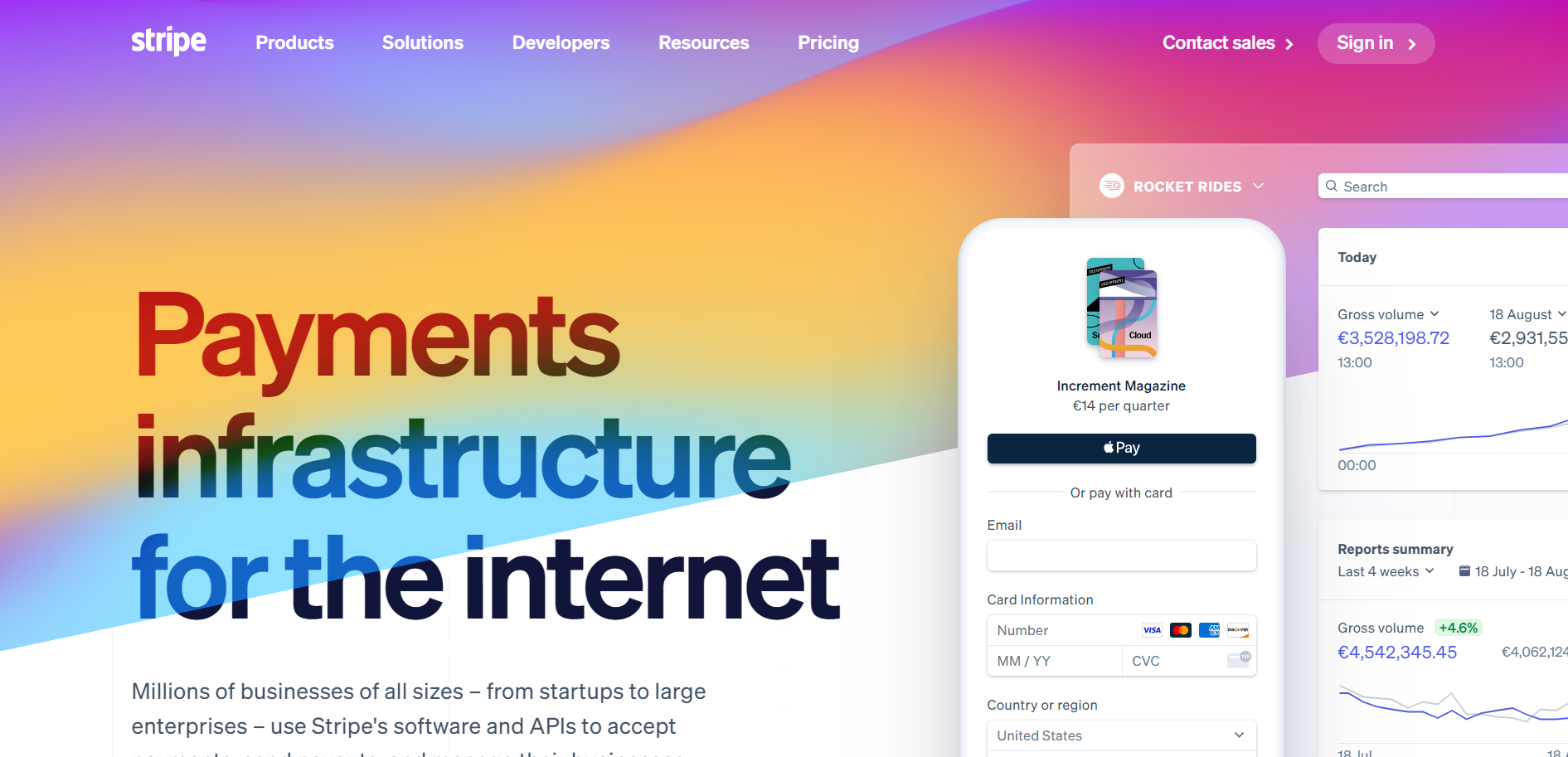
2. Stripe: Financial Infrastructure for the Internet
Stripe is like the rebel service righting a wrong by democratizing online payments. Many merchants and developers have praised the platform - calling it one of the best payment provider for Shopify. Its versatile, robust system, capable of handling recurring transactions and subscription payments.
From advanced reporting tools for customized reports and transparent merchant fees to payout in two business days, this Shopify payment method helps you maximize your working capital. You can even opt for their Instant Payouts option, giving you access to your money in as little as 30 minutes after the transaction. However, that costs an additional 1% of the payout amount plus a minimum fee of 50 cents per order.
And on the fees side of things, Stripe has no monthly fee for services. You pay according to your transactions, typically around 2.9% plus 30 cents per transaction. They also charge a 1% fee for multinational and currency conversion transactions.
Pros of Stripe
Seamless onboarding
No setup, cancellation fees or monthly charges
Instant Payouts option provided
Transparent, flat-rate pricing method
Cutting-edge reporting and subscription tools
Offers multiple payment options and currencies
Customizable checkout workflow and exceptional user experience
Cons of Stripe
Some technical knowledge required
Not accessible in all countries
Doesn't support high-risk verticals
3. PayPal: Digital Wallets, Money Management, and More
PayPal is among the most popular card processing platforms worldwide due to its seamless set and payment processing methods. You can also use PayPal to add Venmo to Shopify.
Another reason sellers love this Shopify payment option is that PayPal makes it possible to accept well-known credit cards, Venmo, pay-later options, and even cryptocurrencies. Their user experience is pretty good too.
Pricing options vary based on the transactions and subscription plans, but they're moderate. Merchants pay 3.49% plus 49 cents per transaction for electronic payments like PayPal, Venmo, and cryptocurrency and 2.59% plus 49 cents for credit/debit card transactions.
More so, PayPal has a Seller Protection Program on eligible transactions. For qualified merchants, PayPal covers losses if a buyer disputes a transaction. However, they charge a non-refundable $20 chargeback fee. Plus, PayPal does not refund transaction fees when customers return their purchases - something to consider if your business handles a lot of eCommerce returns.
Pros of PayPal
Clean UX and friendly brand (trusted worldwide)
Consistent, flat-rate pricing system
Considerable, innovative eCommerce features
Multiple payment options, including Venmo and cryptocurrency
Cons of PayPal
Non-refundable chargeback fee
Unpredictable customer service (holds are not uncommon for new merchants)
Extra fees for multinational cards
Strict policies for emerging markets
4. Apple Pay: Here to pay
Get more from every order
Upsell.com helps you increase AOV with targeted offers across the full shopping journey, from product and cart to checkout, post purchase, and beyond.
Apple Pay helps users conveniently pay and shop online without always needing to enter their card and shipping details. Customers with Apple devices can quickly check out, making it faster than credit cards or cash.
Apple Pay is secure; the platform lets users verify their ID with Touch ID or Face ID. This provides additional reassurance to your customers; they don't need to pull out their wallets again. The user experience is incredibly fantastic on mobile. That means lower cart abandonment rates and improved net conversions.
Apple Pay is equally easy to set up, which explains why some 521.4 million to 535.8 million use Apple Pay. Adding Apple Pay to your Shopify store is like offering a warm welcome mat to such an enormous customer base. Using Apple Pay, your transaction fees remain the same, as Apple Pay won’t add any extra costs on top of what’s charged to the card.
Pros of Apple Pay
No extra fees carried
No internet connection required
An excellent option for mobile users
Super fast NFC-payment system
Secure credit card data system with anonymous, one-time tokens
Cons for Apple Pay
Setup a bit trickier than other competitors
Product release bug might impede functionality
Lower adoption, only accessible to Apple devices
To use Apple Pay on Shopify, you must be using one of the following credit card payment providers, Shopify Payments, Stripe, First Data, Payeezy, Authorize.net, CyberSource, or Braintree.
5. Google Pay: Pay the Google way
Google Pay makes it easy for customers to pay for their purchases with just a few clicks. It's a fast, secure, and convenient way to pay online.
By providing Google Pay as an extra Shopify payment method on your store, you'll give your customers more options for a seamless checkout experience. With Google Pay, customers can use their saved payment information to complete their purchases quickly. The convenience for customers means fewer abandoned carts and more successful transactions for your store. Google uses advanced security measures to protect your customers' payment information.
Companies using Google Pay to manage transactions can also see sales figures and essential information at a glance on their account page. However, not all of the features available for Google Pay will be accessible in every country. Shopify requires that to enable the Google Pay button for your online store, you must be using Shopify Payments first.
Pros of Google Pay
Flexible payment options
Super-convenient for Android users
Considerable compatibility and security
No extra fees for Google Pay transactions
Financial incentives for transactions completed
Cons of Google Pay
Account reconciliation might take a longer time
Product release bug might impede functionality
Not available in all regions
6. Klarna: Attract, convert, and retain customers with flexible payment options
Klarna partners with merchants to facilitate affordable transactions by splitting costs into short-term, interest-free installment loans. Customers also have options for more traditional financing. They're undoubtedly one of the best complimentary Shopify payment options to add to your store.
Merchants pay Klarna so customers can buy now and pay later, expecting customers to buy more. Payments from regions like the United Kingdom or Ireland attract 2.49% + 0.20 GBP per transaction.
Klarna also provides a one-time-use card for online retailers that accept prepaid Visa cards.
With Klarna's one-time virtual cards, buyers can make online transactions anywhere that accepts prepaid Visa. Shopify enables Klarna's payment options by default when you set up Shopify Payments. After Klarna approves your business, customers can check out using Klarna. If you refund Klarna a transaction, Shopify refunds the processing fee charged to you.
Pros of Klarna
Transaction fees are low
Integrating with Shopify is seamless
Smooth and effortless checkout process
Installmental payments offering flexibility
Complete payment at checkout for Shopify store owners
Cons of Klarna
Unpredictable customer service
Charges businesses a fee for each transaction
Vulnerabilities in internal systems opens doors for fraudsters
7. Amazon Pay: Increase conversions by 35%1 with Amazon Pay
Amazon Pay is an easy-to-use payment system that gives customers an efficient way to complete purchases on your Shopify store. The platform integrates seamlessly with Shopify. And they have fantastic offerings, including support for online donations and recurring payments.
Popular brands like Lenovo and Canon use Amazon Pay as their preferred payment method.
You need an Amazon account as a Seller to use the payment system. However, you don’t necessarily have to list products for sale on Amazon. Their inline payment system makes it easy for buyers to checkout without leaving your Shopify store.
Another tremendous benefit of using this Shopify payment method is that customers can access Amazon’s famous A-to-Z guarantee. And if your buyers already have an Amazon account, they can use their saved shipping and billing information when buying something from your store. They don't have to type it again. Thus, saving them a lot of time compared to other tools like Stripe. Amazon also offers express payout, getting you your money faster.
Pros of Amazon Pay
No early termination fees
Taps into brand equity to build trust
Excellent customer service with great UX
Quick integration with inline payment option
Includes Amazon fraud protection as a benefit
Increases shopper engagement with autosaved checkout details
Amazon Pay Cons
Requires Amazon account for setup
Stringent rules on payment disputes resulting in withheld funds
Merchants processing high-volume transactions may incur higher costs for faster processing rates
8. Verifone: Dynamic solutions to create captivating commerce
Verifone, previously called “2CheckOut,” makes our list of the best Shopify payment methods because their customization systems allow merchants to choose only the features their company needs.
Merchants love Verifone online and in-app payments for taking the guesswork out of payment collection and opening up new revenue opportunities for their business.
Their end-to-end encryption, with risk management and compliance tools, helps you keep fraud in check. Apart from tracking fraudulent transactions, you also get resources to manage your tax and maximize your revenue.
If you're looking for an out-of-the-box hosted payment service or want to take complete control of the payment experience through an API, Verifone is your ideal solution. Set up is free, but you pay for each transaction processed.
Square takes this spot on our list of best Shopify payment methods you should know because of its affordable fee structure for small businesses or startups. If your turnover varies monthly, that's a handy perk.
Square has zero monthly fees for the basic plan and a flat transaction fee structure, making the platform popular among small and mid-sized businesses. The customizable experience makes Square ideal for brand-new companies that want a solid payment processing system without spending much upfront.
With Square, you can also determine your end-of-day preferences. The major thrust of Square is its flat-rate fee structure. But things can quickly change as your business begins to scale up.
Another thing to note is that Square has a list of prohibited goods and services, which includes up-sell merchants. If you provide such services, they may freeze your account without prior warning, as specified in the terms and conditions.
Skrill is a great payment system with simple, single integration enabling 100+ local payment options such as cards, digital wallets, instant bank transfers, and other alternative payment tools like cryptocurrency. With Skrill, you can manage over 40 currencies from a single account for more manageable cross-border payments.
Skrill charges lower fees than most card processors, making the platform quite popular among Shopify store owners.
Customers who opt for Skrill as their Shopify payment method will be directed to the Skrill website to input their payment details. After the transaction, they will lead the customer back to the merchant's store.
It's quick and easy to add Skrill to your checkout. Standout benefits include fast checkout with a hosted solution enabling you to add cards, wallets, instant bank transfers, and cash payment methods via a single integration, a digital wallet for customer payments via email address and password, rapid transfer from 3000+ banks worldwide, and partnership with major shopping carts.
Pros of Skrill
One contract and a single API provide simple integration
Chargeback protection with payments indemnification
Competitive processing rates and fees
Enhanced fraud management
Cons of Skrill
Low withdrawal limit can hinder customer spending
Lack of interchangeability between crypto & fiat
Challenges with customer service
You might also like
Marketing
10 Powerful Ecommerce Marketing Automation Strategies to Drive Sales on Autopilot
eCommerce marketing automation allows you to free up time, provide a better experience, and ultimately, make more sales. Discover 10 simple, but proven eCommerce marketing automation examples you can implement to take your store to the next level.
·1 min read
Marketing
eCommerce Personalization: 6 Simple Strategies to Skyrocket Conversions
Personalizing your buyers journey is a fantastic way to boost conversions. Discover 6 simple ecommerce personalization tactics to try today.
·1 min read
Marketing
10 Practical Marketing Ideas For Small Businesses
You don’t need a huge budget to get your business or brand noticed. Our online marketing ideas for small businesses are designed to maximize ROI.
·1 min read
Get eCommerce insights thatconvert
One email a month, practical strategies on conversion, AOV, retention, and customer experience.




 Marketing
